
A message to parents
“Is this my fault?”
“Am I making it worse?
“Does my child hate me?
If you’ve had thoughts like these while your child is struggling with an eating disorder, you are not alone. And the answers to all these questions: No, no, and no.
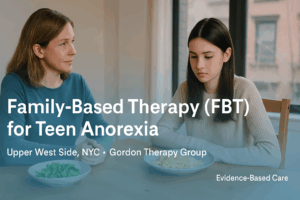
FBT centers you—the parent—as the most powerful part of your child’s recovery. We’ll coach you step-by-step, so nourishment and weight restoration can begin at home, with our team guiding you through each stage—In-person on the Upper West Side and via secure telehealth across New York State.
What is FBT—and why it’s recommended
Family-Based Therapy (FBT)—sometimes called the Maudsley approach—is the leading, evidence-based outpatient treatment for adolescents with anorexia nervosa. Major guidelines recommend a family therapy approach for children and teens with anorexia.
Goals of FBT
- Restore your teen to a medically safe weight
- Re-establish regular, adequately nourished eating
- Gradually return control of eating to your teen
- Support healthy autonomy and family functioning
Why trust FBT? Randomized trials show FBT performs as well as or better than individual therapies for teen anorexia, with superior full-remission rates at follow-up in some studies; parent-focused variants perform comparably. Cochrane reviews continue to support family therapy approaches.
How treatment is structured (3 phases)
Program length: ~20 sessions (weekly, then spaced), with ongoing medical monitoring by your pediatrician/adolescent medicine specialist to ensure safety.
Phase 1 — Weight Restoration
Parents take full lead on meals: plan, portion, supervise, and support after meals. Eating is treated like medicine; school/extracurriculars come after medical stability. (We’ll give you scripts, meal plans, and troubleshooting.)
Phase 2 — Returning Control
As weight and eating stabilize, you gradually hand back appropriate control while maintaining oversight. We’ll stress-test new independence and address anxiety around feared foods.
Phase 3 — Rebuilding Autonomy
Focus shifts to age-appropriate independence, mood, body image, and family dynamics. We’ll create a relapse-prevention plan and coordinate with school supports.
If my teen refuses… what then?
Expect resistance—that’s the illness talking. FBT is built for this: your teen doesn’t need to “buy in” at the start for treatment to work. We empower you to act while your child’s brain is malnourished and thinking is compromised. We’ll coach you through meals and tough moments, then expand your teen’s voice as recovery progresses.
Evidence & outcomes (in plain English)
- Family-based therapy vs. individual therapy: In a randomized controlled trial (people are randomly assigned to treatments), teens who received Family-Based Therapy (FBT) were more likely to reach full remission at 6–12 months than those in adolescent-focused individual therapy. (Lock, Le Grange, et al., 2010)
- Parent-focused version of FBT: A trial comparing parent-only sessions to standard conjoint FBT found similar outcomes at 6 and 12 months. (Le Grange, Lock, et al., 2016)
- Guidelines: The UK National Institute for Health and Care Excellence (NICE) recommends a family-therapy approach for children and young people with anorexia, with ongoing medical monitoring for safety. (NICE Guideline NG69)
We’ll set concrete metrics (weight, vitals from your doctor, meal completion, school attendance, mood/rituals) so you can see progress week by week.
Safety first: medical coordination
Anorexia is serious and can be life-threatening. We coordinate with your medical team to track your vitals, labs, and growth, and we’ll advise if a higher level of care (day program or hospital) is needed due to medical instability. Meta-analyses show elevated mortality risk in anorexia compared with the general population—another reason to act early and assertively.
What sessions look like (practical details)
- Session 1–2: Full assessment, family map, meal support plan, first “supported meal,” MD coordination
- Weeks 3–8: Daily meal structure, coaching for refusals, after-meal rituals, school planning
- Weeks 9–12: Gradual return of control; exposures to feared foods/situations; restore social life
- Final phase: Autonomy work, body image support, relapse-prevention; written home plan
Co-Occurring Conditions: Anxiety, OCD Traits, and Depression
Many teens with anorexia also struggle with anxiety, perfectionism/OCD-like rituals, or low mood. Once nutrition is safer, we layer in targeted tools—CBT, ERP, and skills drawn from ACT/DBT, so your family isn’t fighting the eating disorder and the anxiety alone.
If worry, rituals, or body-image concerns are front and center, you can also work with Dr. Sara Fruchter, PhD, a staff psychologist in Gordon Therapy Group experienced in treating eating disorders, anxiety, and body-image concerns. She integrates family-based work with practical, evidence-based skills.
How we integrate care (after Phase 1)
- Gradual Exposure work for feared foods/situations to shrink avoidance and ritualizing.
- Reducing rituals tied to food, movement, or body checking.
- CBT skills for perfectionism & worry: cognitive restructuring, behavioral experiments, and flexible goal-setting.
- Mood supports: activity scheduling, sleep routines, and gentle social re-entry as energy returns.
- School coordination: brief plans for lunches, PE exemptions during medical recovery, and re-entry supports as needed.
When we add other supports
- Medication is not primary for anorexia itself; it may help co-occurring anxiety or OCD once nutrition stabilizes (decided with your MD).
- We’ll coordinate with psychiatry and school counselors when needed and flag signs that suggest a higher level of care.
Have questions about anxiety or OCD alongside anorexia? Book a free 15-minute consult or see Anxiety Therapy and OCD Therapy for details.
Frequently Asked Questions
Do you diagnose anorexia?
Yes. We provide the psychological evaluation and coordinate with your pediatrician/adolescent medicine specialist for medical clearance and monitoring.
Will my teen need medication?
Medication is not a primary treatment for anorexia. The cornerstone is nutritional rehabilitation plus family-based therapy; meds may target co-occurring anxiety, depression, or sleep as your MD advises.
How long until we see changes?
Many families see early gains in the first 2–4 weeks (more meal completion, weight stabilization), with fuller recovery work continuing over several months. RCTs support sustained benefits at follow-up.
Where we work
We see families on the Upper West Side (Manhattan) and via HIPAA-secure telehealth throughout New York State and New Jersey. Evening hours available for working parents.
Ready to start?
Questions? Email our intake team info@gordontherapygroup.com
Quick “Stats that Matter”
- According to the National Institute of Mental Health (NIMH), eating disorders are serious and sometimes fatal illnesses; early, family-centered care improves outcomes.
- The United Kingdom’s National Institute for Health and Care Excellence states that in teens with anorexia, family therapy is the recommended first-line psychological treatment.
- A 36-study meta-analysis found anorexia has a ~6× higher mortality risk vs. the general population—underscoring the need for prompt, structured treatment.